
The New Work
When we can delegate reasoning tasks with confidence to agents, the nature of work changes.
8/8/20263 min read


When we can delegate reasoning tasks with confidence to agents, the nature of work changes. The new work is no longer about creating outcomes but defining the problem space, orchestrating multiple agentic systems, human interactions, taking legal and moral responsibility, overcoming the necessary frictions. This transition from output to intent is the defining management challenge of the decade.
For centuries, the dominant economic model has treated blue collar physical and relational work as secondary to white collar intellectual labour. By deploying agentic systems at scale, we are actively reversing this hierarchy. The greatest human contribution to enterprise value will soon become our ability to foster human interaction and trust; to get other humans to buy our stuff. Much of the cognitive heavy lifting will be delegated to agents, leaving humans to do what agents can’t do well: build communities, navigate ambiguity, and align collective intent. How does this change what we define as work?
Let’s take a concrete example in software development: what is the “new work” when deploying a new feature?
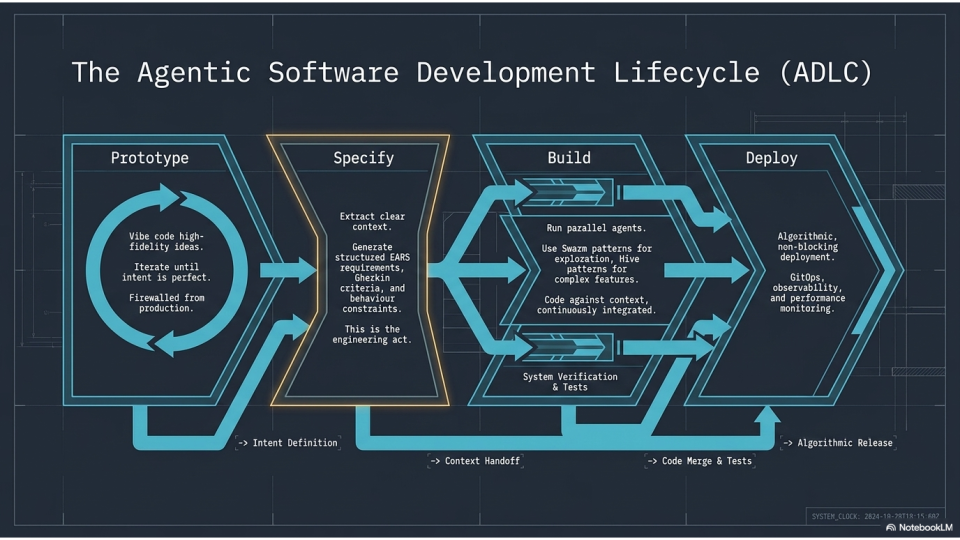
The Agentic Software Development Lifecycle (ADLC) uses agents in different ways. The first prototyping phase is to get a fully clarified intent with the most efficient use of resources. This means full-on vibing to get barely functional mockups in front of real users to shorten the learning loop as much as possible. Humans shouldn’t be in the loop as speed is the key success characteristic.
The second specify phase is critical as the primary guard rail in this workflow. The prototype shouldn’t be allowed near production as who knows what’s under the hood of all that YOLO code. It needs to be rebuilt, but as we now have fully clarified intent, it can be rebuilt better. Spec-Driven Development (SDD) builds in all the guard rails about not just what to build but how to build it (e.g., to follow the LESS engineering principles that I’ve blogged about elsewhere). Agents will reduce the workload to produce the specs, but humans should be fully in the loop here.
Once fully specified, the spec package moves to a coding factory, spinning up parallel agents to build the final artefact. While autonomous, this isn't YOLO development; agents operate strictly within human-maintained guard rails. Humans intervene only as their risk appetite dictates.
Finally, the code is deployed to production. While we will need agents to orchestrate the volume if not complexity of CI/CD pipelines, the deployment actions themselves must remain deterministic and repeatable to safeguard quality. CD requires tested code that executes reliably, not an agent reasoning its way through a deployment every time.
Production is the end of the ADLC but not the finish; we still need to operate the code and the feature. High-frequency agentic deployment inevitably creates complex environments, so we need self-healing agents to observe, correct drift, resolve novel dependency issues, and fix forward. Most importantly, we need to measure the performance of the feature to ensure that it matches our intent.
The new work becomes: clarify the intent of the feature, engineer the context that drives agent execution, maintain the guard rails for the system, validate according to risk, and measure its performance against original intent. The work is different, but we still own the feature.
But just because agents can do something doesn’t mean that agents should. Just because we could simply ask Claude to deploy into production and trust its judgement, doesn’t mean we should get rid of our CD pipelines. Efficiency isn’t about delegation, it’s about judgement. In this example, the token burn doesn’t make financial sense, not when there’s highly optimised ops tooling available.
For now, the important work for humans is to retain fiscal, legal and moral responsibility by managing the guard rails that our agents operate within.
© Mind Rocket Services Ltd 2026. All rights reserved.
Avi Sinharay
CEng, MIET, MEng, MA (Cantab.)
Fractional CTO, Director/VP of Technology
Core Expertise
Technology Leadership, AI Native Dev, Operating Model Design, Engineering Culture
Domains
Health Tech, Media Tech