
LESS Through Japanese Principles
I’ve found Japanese philosophy to be inspirational. It expresses complex and profound ideas with simplicity and elegance.
SOFTWARE ENGINEERINGCOACHING & LEADERSHIP
5/30/20261 min read
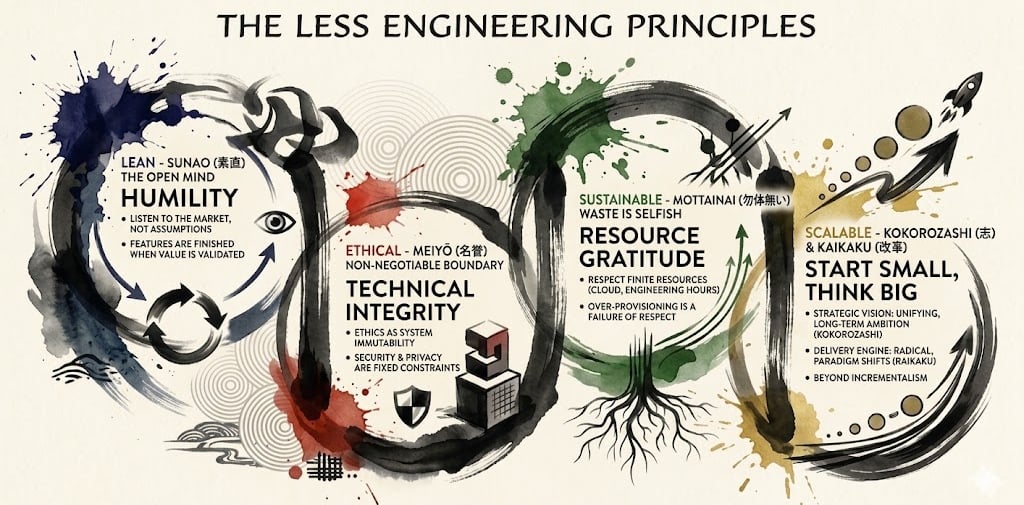
I’ve found Japanese philosophy to be inspirational. It expresses complex and profound ideas with simplicity and elegance. In a previous post I introduced my LESS engineering principles. Let’s look at expressing LESS with Japanese philosophy.
Lean maps to Sunao (素直) the open mind. This is the intellectual humility required to listen to the market rather than your own assumptions. Having a Sunao mind means accepting that your initial code, architecture, or product hypothesis is merely a guess. It dictates that you cannot call a feature "finished" when the feature flag is toggled, but only when user telemetry and market adoption validate its utility.
Ethical maps to Meiyō (名誉) or a non-negotiable boundary. Ethics is an immutable, hard technical constraint. Just as an engineer would not compromise on the laws of thermodynamics or basic arithmetic to make a system run faster, they cannot compromise on Meiyō. If a feature cannot be delivered ethically within the allocated time and budget, the “iron triangle” is unviable. The deadline moves, or the scope shrinks, but the ethical baseline remains fixed.
Scalable maps to the twin principles of Kokorozashi (志) and Kaikaku (改革) or think big but start small. Kokorozashi describes a unifying, long-term ambition that goes far beyond a standard corporate goal or commercial target. It is a resolve to solve a massive, structural problem for society or an industry. Kaikaku is the deliberate introduction of a paradigm shift. It rejects the idea that a system can always be improved by tweaking the edges. It demands that you occasionally tear down old assumptions to move to an entirely new tier of performance.
Sustainable maps to Mottainai (勿体無い) or the idea that waste is selfish. When we consume shared resources (cloud compute budgets, engineering hours, hardware lifespans) to build features the market didn't ask for, it is equivalent to using those finite resources to serve our creative whims. It is a failure of respect for the materials and the energy invested in them.
© Mind Rocket Services Ltd 2026. All rights reserved.
Avi Sinharay
CEng, MIET, MEng, MA (Cantab.)
Fractional CTO, Director/VP of Technology
Core Expertise
Technology Leadership, AI Native Dev, Operating Model Design, Engineering Culture
Domains
Health Tech, Media Tech